Designers: Your Vibe-Coded Prototype Isn’t “Real” Until You Define SSOT
I'm a product designer, and my default is always to start with the interface — which is exactly why this SSOT lesson hit me so hard.
If you've ever vibe-coded with tools like Cursor, you know the rush: vibe-coding spins up screens, buttons, and flows in minutes. It runs. The UI looks polished. And you think, "This is basically done."
I rebuilt my project twice before it clicked: what makes a tool survive isn't UI polish or clever prompts. It's whether you've defined a stable SSOT — a Single Source of Truth.
"It runs" is vibe-coding's most convincing illusion
The first time I seriously used vibe-coding to build a tool, progress felt unreal. Screens appeared. Interactions worked. It looked like a real product.
Then I started testing it properly. That's when the nightmare began.
There weren't many catastrophic, app-crashing bugs. Instead, it was filled with the most maddening kind of "almost-bugs" — things that felt subtly wrong:
- Click around a bit and state would get weird
- Change inputs slightly and results became unpredictable
- Nothing fully broke… but I couldn't trust it
The feeling was crystal clear: I wasn't building a product. I was patching a system full of holes.
Fix one thing, another breaks. Adjust here, something else goes out of sync. The codebase became unmaintainable, and eventually I gave up and rebuilt it from scratch. The second time? I moved faster — and slammed into the exact same wall.
That's when I finally woke up: what I needed wasn't a better model or more sophisticated prompts. I needed one unshakable center of truth inside the system.
This is especially deadly for designers. We're visual-first by default. It's easy to mistake "a working interface" for "a working product." And once you fall into that illusion, you enter a loop:
generate → test → find weird bugs → fix → create new bugs → test againThe only way out is to allow one truth, not many.
SSOT in designer terms (you've used it before)
Designers already understand SSOT — we just don't always call it that.
Example 1: Design tokens
Anyone who's built a design system knows this pain: you want to tweak your brand blue slightly. Without tokens, it's a disaster. You're manually hunting hex values across pages and components. You will miss some. Your product ends up permanently inconsistent.
Tokens are SSOT for the visual layer. Color, spacing, typography "facts" live in one place, and everything else references them. Without tokens, you think you're designing — but you're really just playing "find the differences."
Example 2: Figma components
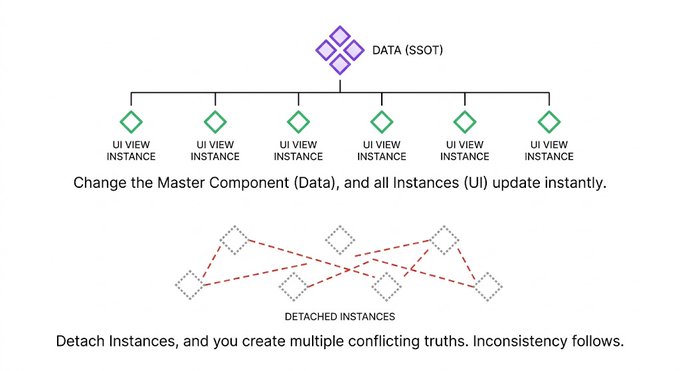
If your button is a component, one radius update propagates everywhere. But if you copy/paste buttons or detach instances, you've created dozens of competing "button truths." Now consistency is impossible.
That's SSOT in its most obvious form:
My Granny Square Studio "click" moment
When I started building my granny square chart tool, I hit the most fundamental question: What is the SSOT?
Is it the Design — the canvas, the grid, the layout, the rendered visuals? Or is it the Stitches — the stitch objects and the relationships between them?
As a UX/UI designer, my instinct was to lead with visuals: start from the chart, define the UI, shape the interactions. I was constantly pulled by what looked right.
But testing taught me something painful: UI is fragile. Layouts change. Rendering changes. Interaction patterns evolve. If you anchor "truth" to visual output, a small UI shift can collapse the logic underneath.
So I made a hard decision: I locked SSOT to Stitches. Because for this tool, the most stable, least negotiable truth is the stitch structure itself. Once that truth is fixed, everything else becomes a derived view:
Stitches (SSOT) → Chart Render (UI) → Written Instructions (Text) → Editing Interactions (Actions) → Export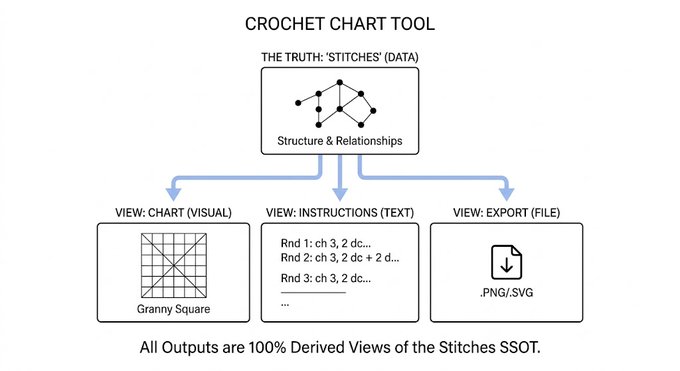
And that's when the system finally started to feel… solid.
Why bugs become impossible without SSOT
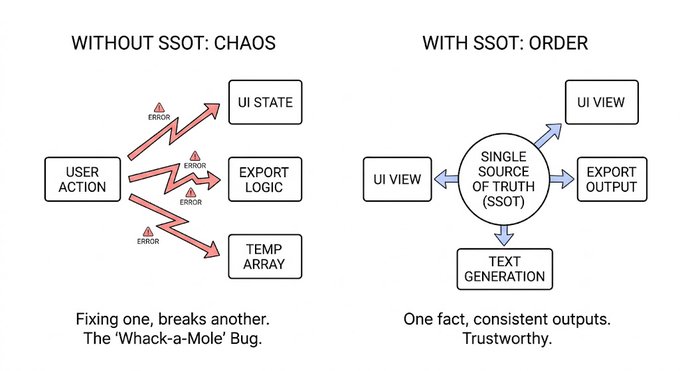
Because your system becomes psychologically split — it's maintaining multiple competing realities.
Take something simple: "Which stitch connects to which?" If you store one version in UI coordinates, compute another in export logic, and keep another in a temporary array… then the moment you change layout:
- the on-screen lines might look correct, but exported instructions are wrong
- or the instructions look right, but click-to-edit behaves incorrectly
You think you're fixing bugs. But really, you're doing therapy for three truths that don't agree with each other.
The SSOT checklist I use before I build anything now
- What is the core object of the system? (For me: a stitch)
- What's the minimum required schema? (ID, type, relationships, etc.)
- What is absolute truth, and what is merely derived display state?
- If UI and data disagree, who wins? (SSOT always wins.)
Vibe-coding doesn't let you skip thinking — it drags you back to the only thinking that matters. Vibe-coding can generate UI in seconds, but it can't decide your data skeleton for you. If SSOT isn't defined, you're not building a product — you're building a shell that shatters on contact.